
Check the Phillips County Current Owner Card
Start with the Appraiser. That record is the present-tense view of ownership in Phillips County, and it carries the parcel identity alongside the name. Keep both together.
| Owner name | The owner label used for parcel and valuation work |
|---|---|
| Mailing address | The destination used for official owner mail |
| Situs address | The parcel's physical location |
| Legal description | Lot and block or section-township-range identity |
| Deed or sale clue | A date or reference to test against recording records |
For the official assessment record, use the Phillips County Appraiser real-estate page. It explains the annual valuation context behind the entry.
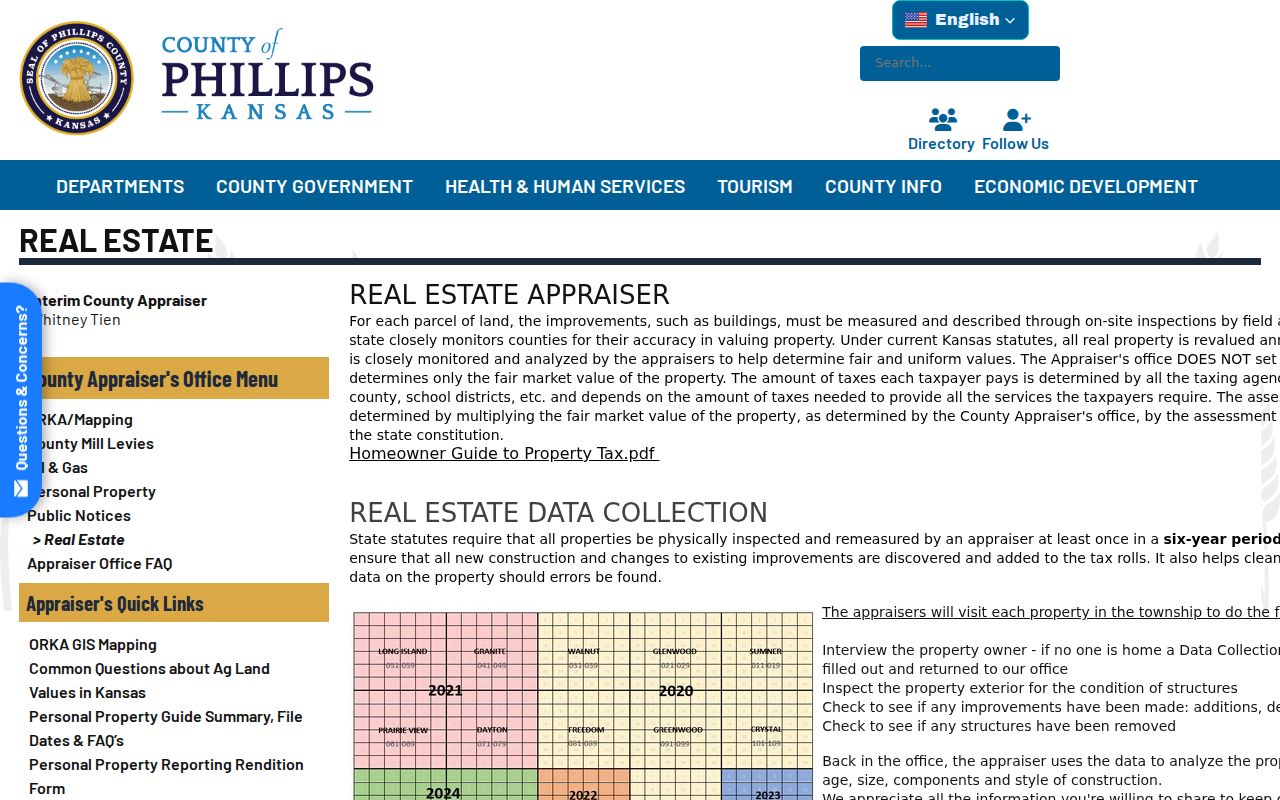
The county's own page describes the annual valuation role behind each record. That still does not tell you who occupies the land. A mailing address can differ from the situs. The displayed owner may be a trust, an estate, a company, or a joint ownership. Read the card with that in mind.
Confirm the Current Phillips County Owner
The real check is the latest deed. Phillips County publishes no online deed documents and no web grantor-grantee index. Confirmation therefore continues through the Register of Deeds, where any later title-affecting instrument can be reviewed.
- Locate the parcel through ORKA or request its Appraiser card.
- Copy the owner label and complete legal description.
- Request the latest deed by description, party, date, or book/page from the Register of Deeds.
- Read the grantee, vesting, recording date, and later affidavits or corrective instruments.
- Owner of record
- The party named in the administrative ownership record.
- Vesting
- The deed wording that states how a grantee holds title.
- Recording lag
- Time between recording and an update elsewhere; Phillips County publishes no standard interval.
Date the Phillips County Owner Record
A deed can record while ORKA or the Appraiser still shows the prior owner. Timing explains most mismatches. Check for a later affidavit of death, probate order, divorce decree, or corrective deed tied to the same legal description. It should match the same legal description. Record both access dates rather than guessing at the unpublished lag between offices.
Recent-sale gap. The assessor owner label can lag a transfer. The newest recorded deed is the more current recorded clue, though title questions need professional review.
Verify a Phillips County Entity Owner
When the owner is an LLC or corporation, use the Kansas Business Entity Search. Search by business name or SOS ID. The Contains and Starts With filters help separate similar names. Results stop at 200 matches. Status and resident-agent details explain the entity filing. An agent is not automatically the current property owner in Phillips County, though. Sole proprietorships, assumed names, and DBAs may not appear at all. The deed remains the link between the entity and the land.
Read Phillips County Joint Ownership
Joint-tenancy wording matters after a death. County guidance says the surviving owner usually records an affidavit of death or a death certificate as appropriate. A probate or divorce record can explain the change. Still, the current-owner conclusion should identify the resulting recorded instrument. Note that Kansas vital records are not public. Eligibility and identity rules apply even when a real-estate filing refers to a death.
Document a Phillips County Current Owner Conflict
Conflicts have ordinary causes. A parcel split may change a description, a tax bill may use an earlier mailing address, and a court matter may precede recording. Log the source, date, displayed name, legal description, and instrument reference. Send that focused conflict to the custodian. Never pick the record that merely looks newer.
Note: A current-owner answer is strongest when the assessor label and latest recorded grantee match the same legal description.
Protect Phillips County Owner Addresses
Owner addresses deserve care. Kansas Safe at Home lets eligible participants use a substitute address. It works with state and local agencies. Preserve any protection or redaction. Never combine voter, court, tax, license, or map sources to infer a confidential location. ORKA also warns against knowingly giving, receiving, or selling name-and-address lists. These lists come from property records and are barred for property or service solicitation. The notice describes possible misdemeanor consequences.
That limit does not block a parcel-specific check. A sale, estate, boundary, easement, or tax question still fits. It does mean any Phillips County lookup should stay tied to land records. A project should not become a list of people or addresses.
Ask for the Phillips County Current Owner Record
The Register of Deeds accepts focused requests in person at 301 State Street, Suite B, Phillipsburg, by phone at 785-543-6875, or by email through the contacts on its official page. Office hours run weekdays from 8 a.m. to 5 p.m., closing from noon to 1 p.m. State the property address, full legal description, owner label, likely deed type, and a narrow date range. Ask for the latest deed and any later instrument affecting the named grantee.
Small copies other than UCC filings run $0.50 per page. Indexes and reports cost $1 per page. Large work exceeding one hour and 50 pages can be billed by the hour under K.S.A. 45-219(c)(1). Confirm the current cost before ordering.
Note: A narrow legal-description request fits Phillips County's staff-assisted access model better than a request for every record tied to a common name.
Separate Phillips County Current Owner Clues
The Clerk maintains county real-estate records by address, legal description, and owner name. Transfer sources can include deeds, probate, divorce decrees, and death certificates. The Treasurer collects and distributes property tax. A tax account addressed to a person is not, by itself, title proof. A city permit can name an owner, applicant, contractor, or agent. Those roles are not interchangeable.
The Appraiser determines value and maintains property characteristics. Taxing agencies set levies. That division matters. A value notice, tax receipt, and deed can all name the same parcel while answering different questions. A Phillips County current-owner conclusion should rest on the current parcel clue and the last recorded title instrument. It should not rest on whichever document is easiest to reach.
Match the Phillips County Current Owner to the Land
A matching name proves little on its own. The parcel description has to match too. For a lot in Phillipsburg, Logan, or Agra, hold onto the townsite or subdivision name, the block, and the lot. Keep the plat too, along with any book and page reference. Rural parcels work differently. There, the section, township, range, acreage, and tract wording carry the identification. Those recorded phrases keep identifying the land even after a street address changes.
When the descriptions refuse to line up, look for a reason in the records themselves. A plat, a survey, a lot split, or a boundary change may explain the gap. So may a corrective deed. A GIS polygon helps you compare shapes and locations. But it is not a survey and cannot settle a title question. A careful Phillips County owner of record entry will show which description came from the map. It also shows which came from the card, and which came from the deed.
Depth matters here. Phillips County dates its settlement and organization to the nineteenth century. The recorder's deed records reach back to 1873. That long history explains why a modern parcel number may not appear word-for-word inside an old instrument.
Check Later Phillips County Owner Instruments
The newest document in the index is not automatically the newest conveyance. Plenty of papers arrive after a deed without changing the grantee. A mortgage, an assignment, a release, an easement, a lien, or a power of attorney can all be recorded later. Even so, they still leave the current owner untouched. Read the instrument's purpose and cross-references before assuming any later entry transfers the parcel.
Some instruments change how ownership gets reported rather than who holds it. An affidavit, a real-estate death certificate, a trustee instrument, a sheriff's deed, a corrective deed, or a court-certified order can each shift the picture. Phillips County recording guidance asks for originals or certified copies. It also expects signatures, notarization, named parties, and a complete legal description. A paper that gets rejected or never recorded will not show up as the answer to a current owner search.
Note: Compare each instrument's purpose, not just its recording date; a newer release can clear debt without transferring the Phillips County parcel.
Use a Phillips County Current Owner Record Lawfully
A public mailing address is an administrative clue. It is not proof of residence. Keep any contact tied to a legitimate parcel matter, and record the source date alongside whatever note you keep.
Lawful use. Phillips County owner information may support property diligence and civic research. It must not be used to stalk, harass, intimidate, or harm anyone.