
Identify Who Owns a Phillips County Property
No single county screen proves ownership in Phillips County. Pair a free ORKA parcel clue with the county's offline recording record. Start from an address when you have one. Keep the legal description handy. A rural tract or an old town lot may be described by section, township, and range, or by a plat, block, and lot, rather than a modern street label.
- Open the Phillips County ORKA entry, accept its public-use notice, and locate the address or place.
- Copy the parcel label, owner-of-record clue, situs, and legal-description text that the map actually displays.
- Ask the Phillips County Register of Deeds for the latest deed tied to that legal description and compare its grantee and recording date.
- If an entity is the grantee, check its filed identity in the Kansas Secretary of State search without treating the agent as the landowner.
Each step below names its source. The route also exposes conflicts. A new deed paired with an older assessor label gets flagged rather than hidden, so you know which record carries which date.
Phillips County Property Owner Source Trail
Four offices answer four different questions. The Appraiser keeps parcel and ownership data for valuation. The Register of Deeds holds the deeds and other instruments that actually convey or affect title. The Clerk indexes real-estate entries by address, legal description, and owner, while the Treasurer collects the tax bill without deciding who owns the land.
| Where ownership is shown | What it contributes | How current |
|---|---|---|
| Appraiser and ORKA | Parcel location, owner label, valuation context | Useful current clue; update lag is not published |
| Register of Deeds | Latest recorded grantee, vesting and legal description | Current through the last located recording |
| County Clerk | Address, owner and legal-description cross-check | Administrative tax-roll context |
| Kansas SOS | Entity name, status, SOS ID and resident agent | Entity filing context, not title |
An occupant, tax mailing address, permit applicant, or resident agent may not be the owner at all. Keep each label tied to its source.
Use Phillips County ORKA as the Parcel Clue
The ORKA route for Phillips County opens a Kansas GIS ArcGIS Experience, not a stable Phillips-only owner database. Its geocoder covers Address or Place, city, county, state, ZIP, and related address fields. Results cap at six suggestions. No county-specific parcel panel is part of the service. Owner labels may stay hidden, in which case the Phillips County Appraiser can supply the Property Record Card. The card adds square footage, room count, outbuildings, class, and value details. The Phillips County real-estate page explains this appraisal context. The card is a parcel match, not a deed.
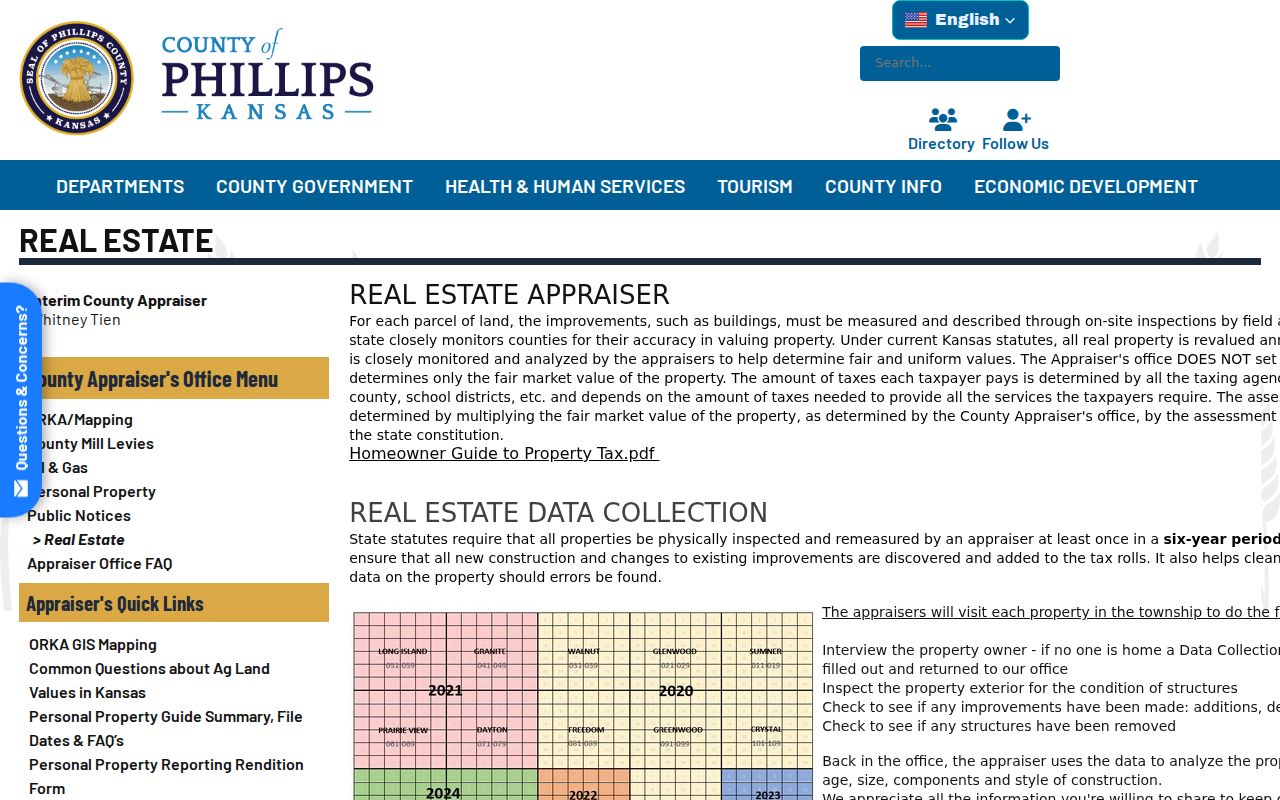
The county's official valuation office is the place to call when ORKA shows no owner field. Those appraisal facts help you match the parcel. They still do not replace a deed. Recorder instruments carry the ownership answer in Phillips County.
Note: Save the exact parcel and legal-description labels from ORKA before you leave; a specific recorder request works far better than an address alone.
Trace the Phillips County Owner to a Recorded Deed
Phillips County draws a hard line on access. The Register of Deeds offers no online deed documents, no web-based grantor-grantee index, and no e-recording. So the work happens in person or by phone. Visit 301 State Street, Suite B in Phillipsburg, call 785-543-6875, or email a focused request using the contacts listed on the official recorder FAQ. The office keeps weekday hours from 8 a.m. to 5 p.m. It closes for lunch between noon and 1.
When you reach the staff, be specific. Provide the legal description, the address, any suspected party names, the instrument type, and a tight date range. Ask for the most recent deed plus anything recorded after it, such as an affidavit, corrective deed, probate order, or divorce decree that could change the answer. Copies of small documents other than UCC records run $0.50 per page, while indexes and reports cost $1 per page. Confirm the current charges before you place an order.
Terms Behind a Phillips County Property Owner Result
The same name can play several roles in one file, so vocabulary prevents overstatement.
Owner of record: the name an official administrative record carries. Grantee: the party receiving an interest under a deed. Vesting describes how title is held, and situs is the property's physical location, which can differ from the owner's mailing address.
The current owner may be joint tenants, a trust, an estate, an LLC, or a corporation. Read the deed's capacity and vesting language. Never shorten the name into an individual.
Identify a Phillips County Entity Grantee
An entity grantee needs one more lookup. Search the Kansas Business Entity Search by exact business name or Kansas SOS business ID. Contains and Starts With name searches also work. A resident-agent route is available too. The tool caps matches at the first 200 results and warns that the business ID is not a federal tax number.
Filings separate similar names and show status. They do not prove a resident agent, manager, member, or registered office owns the parcel. Sole proprietorships, assumed names, DBAs, and trade names may not appear at all. The deed links the entity to Phillips County land.
Report Conflicting Phillips County Owner Records
Ownership labels can disagree between Phillips County systems. A deed recorded after a recent closing often reaches the recorder first. The assessor display catches up later. A parcel split may rewrite a legal description. A surviving joint tenant may still need a later affidavit. Probate filings can surface in court before any instrument reaches the recorder. Phillips County publishes no standard lag between recording and an ORKA or Appraiser update.
Document what each system says. Record the date, the exact source label, the deed reference, and the description. Then ask the office whether a later entry or corrective filing exists. For a decision that hinges on title certainty, rely on a Kansas title professional. The Phillips County current-owner guide concentrates on this present-record check.
Note: A mismatch is a finding to document. Do not pick whichever owner name looks newest.
Limits on Who Owns a Phillips County Property
An owner label has firm limits. It does not name everyone living at an address. It cannot reveal an unrecorded transfer, settle every trust term, or promise clear title. City building permits name applicants and contractors, not necessarily owners. Treasurer records speak only to tax status. A court caption may explain a dispute, yet a docket entry alone conveys no land.
Use owner records carefully. The assessor label is not a title search. Kansas restricts name-and-address lists from property records for solicitation, and this information must never be used to harass or target a person.
Safe at Home can give eligible participants a substitute address. Do not try to reverse a protected or substitute address through any other public source. For a lawful parcel issue, stick with the parcel, the legal description, and the custodian's response.
Trace a Phillips County Property Owner Across Three Descriptions
Older Phillips County land rarely traces cleanly by street address alone. Hold three descriptions together. Keep the current situs, the ORKA or Appraiser legal-description label, and the oldest wording found in the recorder or Kansas Historical Society record side by side. A rural tract may shift from section-township-range to an acreage description, while a city parcel may move from townsite, block and lot to a modern map identifier.
The county's railroad-era growth explains the odd clues. A deed, plat, right-of-way, depot lot, or easement may lean on a townsite or rail-related term. That context helps you locate the next instrument. It does not establish ownership. Carry the description back to the recorded conveyance itself.
Recorder holdings reach as early as 1873. When the chain reaches a patent or original federal tract, the Kansas Historical Society land-record guidance is the right resource. Its tract-book route runs by legal description rather than owner name. Later transfers lead back to Phillips County.
Write a Phillips County Property Owner Request
A narrow records request works best. State the parcel address and the exact legal description. Add suspected owner or party names, the likely instrument type, and the smallest useful date range. Ask for the latest deed plus later instruments. Do not request every paper tied to a common surname. Whenever ORKA, an older deed, a plat, or another office supplies a book/page or instrument number, include it.
Probate and divorce transfers open a second door. The District Court may provide public case information through Kansas district-court access, a courthouse terminal, or a written records request. Sealed, adoption, juvenile, child-in-need-of-care, grand-jury, expunged, and other protected records stay unavailable. Any case clue still must be reconciled to the deed. It can also be reconciled to the court-certified order in the land chain.