
What Phillips County Deed Records Show
The Phillips County Register of Deeds files deeds plus a long list of companion instruments: affidavits, mortgages, assignments, releases, oil and gas leases, agreements, easements, powers of attorney, plats, surveys, real-estate death certificates, UCC filings, and several kinds of liens. Know the difference before you dig. A deed records a conveyance. A mortgage or lien records an encumbrance, and neither one moves ownership.
| Deed Type | What It Does | Common Use |
|---|---|---|
| Warranty deed | Conveys the stated estate with covenants | Ordinary sale |
| Quitclaim deed | Conveys only the interest the grantor has | Family or interest cleanup |
| Executor or trustee deed | Conveys through an authorized fiduciary | Estate or trust transfer |
| Tax deed | Records a conveyance following tax proceedings | Delinquent-tax transfer |
| Affidavit of death | May document a death affecting jointly held title | Survivorship record trail |
When you read a deed, work through the granting language, the parties, the dates, the acknowledgment, the legal description, and any recorded references. Recording gives the public notice of the instrument. It does not make the recorder a guarantor of title.
Phillips County's Deed Search Is Staff-Assisted
Phillips County keeps its deed search staff-assisted. The county's official FAQ confirms there is no e-recording. There is no online document collection, and no web grantor-grantee index. You can search in person at 301 State Street, Suite B, in Phillipsburg. Telephone works too, at 785-543-6875, as does a specific email request. The office lists records reaching back to 1873 and can help locate a lost deed.
Make the request concrete. Give staff a full legal description. Include names with alternate spellings or initials, a likely document type, and a practical date range. For an older town lot, include the plat, block, and lot. For rural ground, add section-township-range, acreage, a road or creek, or patent clues.
The Register of Deeds FAQ documents the county's offline deed-access model.
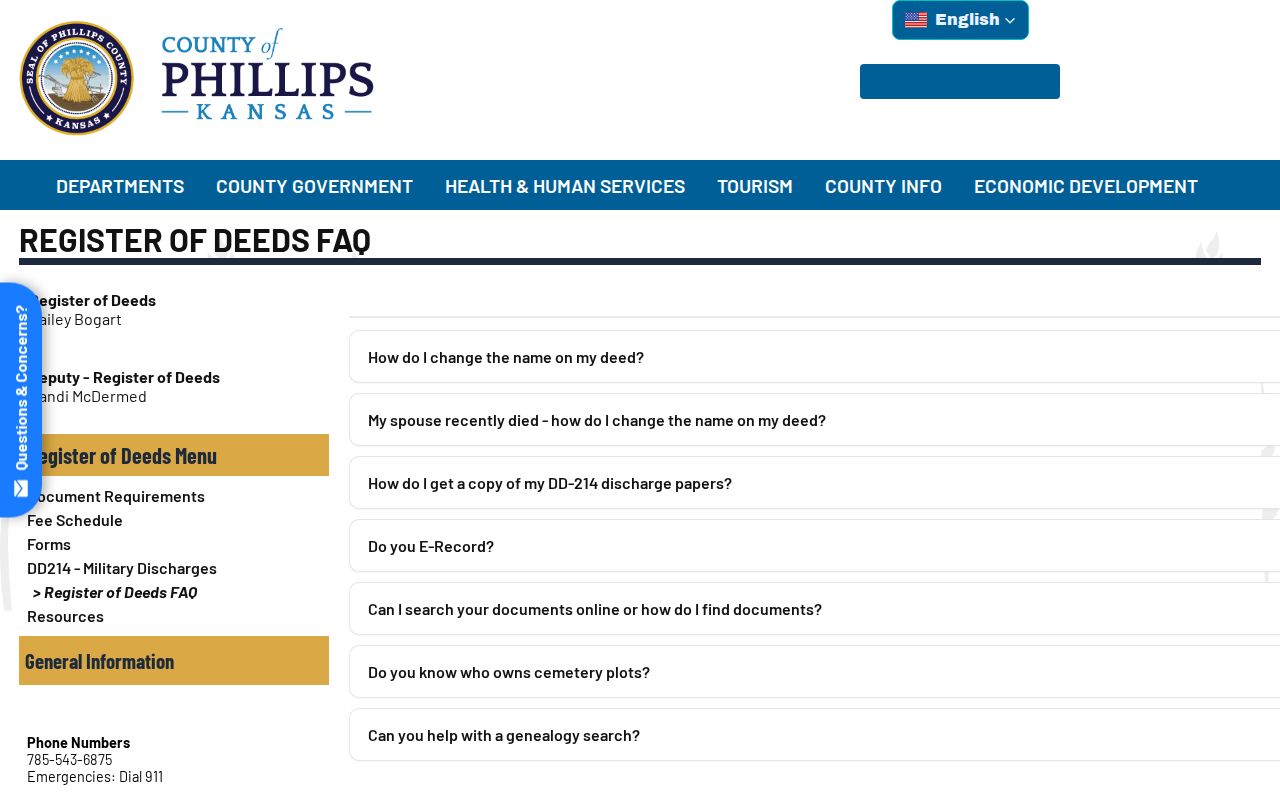
The FAQ page describes the visit, telephone, and email routes; it is not an online deed-result screen.
Capture the Fields That Keep a Chain Intact
| Identity | Instrument type, grantor, grantee, and entity or estate capacity |
|---|---|
| Placement | Recording date, book/page or instrument number, and county |
| Land | Complete legal description, lot/block, or section-township-range |
| Timing | Execution, acknowledgment, recording, and effective dates when distinct |
| Cross-reference | Prior deed, mortgage, release, plat, survey, or court order |
Phillips County publishes no sample deed result online. A careful request and a thorough transcription of what staff return will serve you better than field names borrowed from some other county's portal.
Follow the Phillips Grantor-Grantee Index
Follow the legal description, not just a familiar name. One party can own several tracts. Older entries may list only initials or variant spellings, so the land description is the anchor.
- Locate the newest conveyance and verify its legal description.
- Record its grantee and grantor, dates, and book/page or instrument reference.
- Search the grantor as the grantee in an earlier acquisition.
- Repeat, cross-checking plats, probate instruments, and releases when the trail changes form.
- Grantor
- The party conveying the stated interest.
- Grantee
- The party receiving that interest.
- Chain of title
- The linked sequence of recorded ownership instruments.
- Book/page or instrument number
- The recorder's locator for the filed document.
Older Phillips Land Trails Begin in 1873
Land trails in Phillips County run deep. The recorder says holdings reach as early as 1873. The files may include ownership and patent material. The Kansas Historical Society plat-book guide can add rural owner names. It also offers church, cemetery, school, and road clues. Federal tract books and original surveys help with the initial land entry. Treat historical maps as finding aids. The deed books still hold the county's true conveyance chain.
Meet Phillips County Recording Requirements
The county's document requirements set a clear bar: an original or certified copy, signatures, proper notarization, identified parties, and a complete legal description. Margins matter too. The first page needs a three-inch top margin with one-inch margins elsewhere, and later pages use one-inch margins throughout. Deeds also require a Real Estate Sales Validation Questionnaire under K.S.A. 79-1437c unless an exemption under K.S.A. 79-1437e applies. Statute closes that questionnaire. Court instruments must be original or court-certified under K.S.A. 58-2242a.
A relevant death filing needs the proper state-certified document. These rules explain why an informal ownership change or a website correction can never substitute for a recorded instrument.
The county's recording-requirements page is the practical checklist for any document headed into the Phillips County deed records.
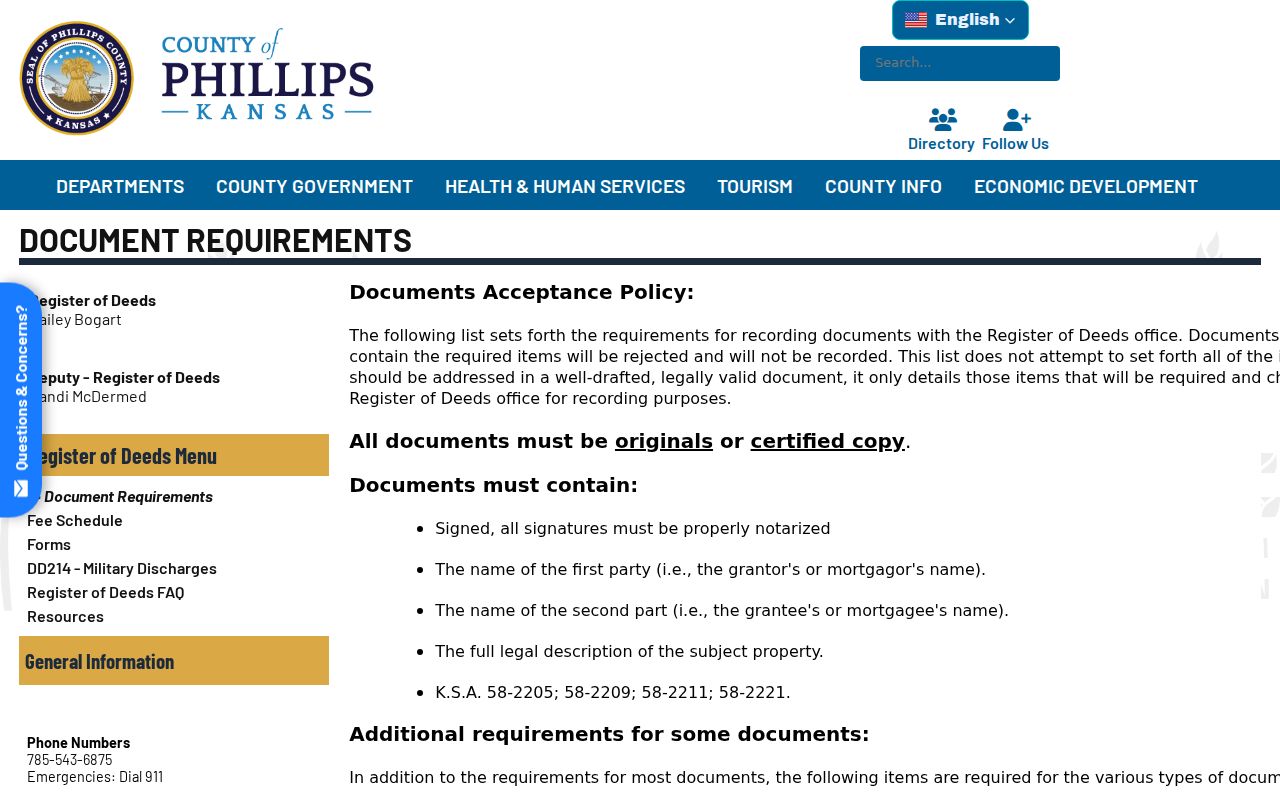
The requirements page shows why the recorder examines document form and legal-description detail before accepting a filing. Acceptance is still not a title opinion.
Distinguish Phillips County Deeds from Encumbrances
A deed is one instrument among many in the Phillips County recording system. Mortgages, assignments, releases, easements, oil and gas leases, powers of attorney, tax liens, UCC fixture filings, surveys, and plats sit beside the conveyances. Any of them can shape a property's story without naming a new fee owner. A mortgage assignment should point back to the original book and page. A release or revocation should identify the instrument it changes.
Read what the instrument actually does before adding it to an ownership timeline. A mortgage secures debt. A release can show satisfaction. An easement grants a defined use right. A survey may explain a line. A plat establishes a lot framework. A later recording date alone never makes any of these an owner transfer.
Note: Preserve every referenced book and page. That cross-reference may be the shortest route to the deed, release, plat, or survey you need next.
Use Phillips County Deed Forms as Field Guides
The Register of Deeds forms page offers a quitclaim deed, the Sales Validation Questionnaire, a mortgage-cap affidavit, UCC forms, a UCC11 information request, and mobile-home title-elimination materials. None of these form a searchable deed index. They still earn a look, because they reveal the identifiers staff need to connect a request with the right record.
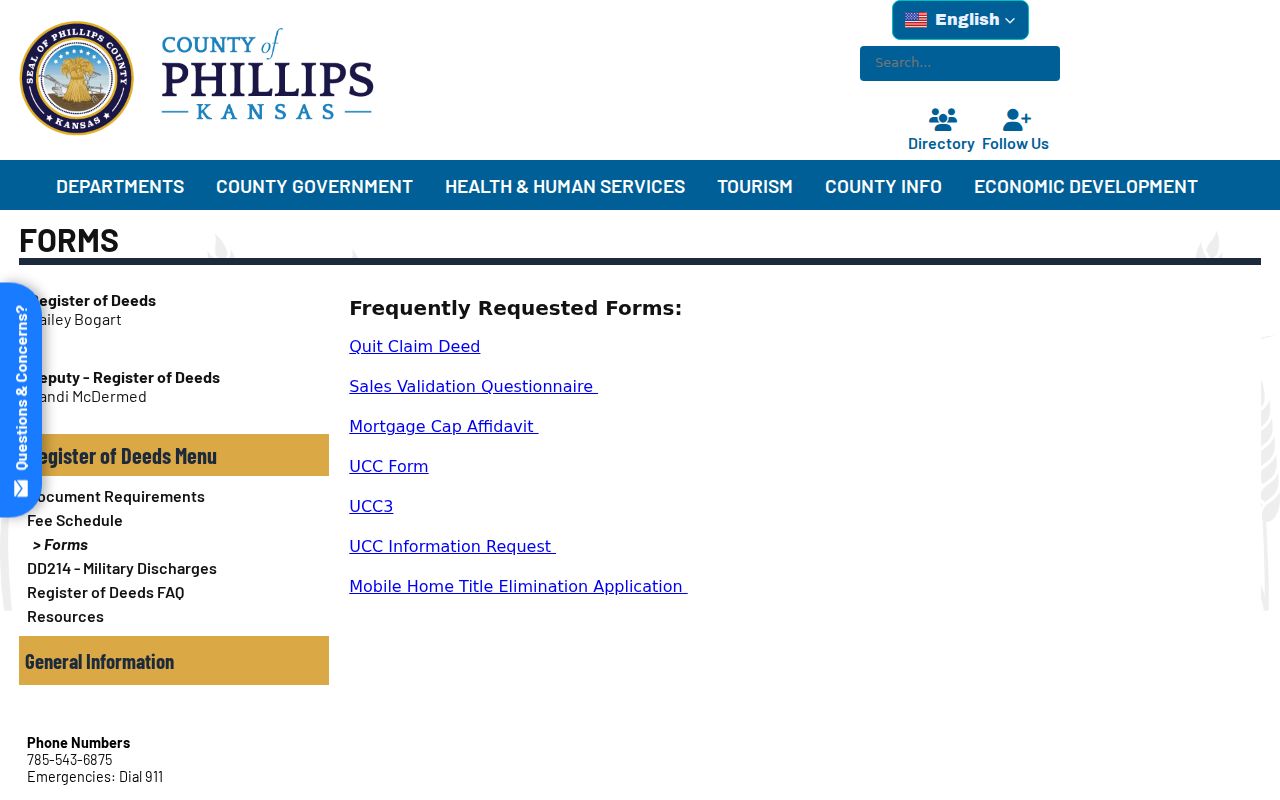
The forms list helps you tell a deed request apart from a UCC search or a title-elimination filing. Match the form to the instrument. Not every property question belongs in a deed template.
The county's UCC11 request separates an organization debtor from an individual surname and given name. You can choose ALL or UNLAPSED scope, optional certification, specific record numbers, copy choices, and pickup or another delivery method. The form prints no fee. Confirm the current charge with the office.
Connect Phillips County Probate Records to the Deed Chain
Some conveyances answer to a courtroom first. Probate, divorce, foreclosure, and quiet-title matters often explain why the next Phillips County deed names an executor, trustee, sheriff, or estate. Phillips County sits in the 17th Judicial District. Public case information runs through the Kansas district-court records route. Courthouse terminals and written requests cover the public material that never reaches the internet.
A caption alone will not carry the parcel. Pull the actual judgment or order, then match it to the recorded deed or court-certified copy sharing the same legal description. Some files stay closed. Sealed cases, adoptions, most juvenile matters, child-in-need-of-care cases, grand-jury proceedings, and expunged records sit outside public access.
Kansas vital records follow their own rule. A real-estate death certificate recorded with a deed is not the same thing as a certified death record open to anyone. KDHE restricts certified copies by eligibility and identity. Ask the recorder which lawful filing applies instead of treating private vital material as a shortcut.
Bridge Rural Phillips County Deeds with Three Descriptions
Track three descriptions at once. Put the modern situs on one worksheet. Add the ORKA or Appraiser label. Add the earliest recorder wording too. Rural ground drifts from federal section-township-range language into acreage or tract wording. Town parcels change too. A townsite plat with block and lot may become a modern parcel identifier. Searching only the newest label is risky. An intact chain can look broken.
The county's railroad-era past offers leads. Townsite plats, rights-of-way, depot lots, and easements from that settlement wave often explain odd boundaries. Historical newspapers and ownership atlases can suggest a period or a name to request. They never replace the Phillips County deed records. When the chain reaches an initial patent or federal entry, use Kansas Historical Society tract-book and survey resources. Then return to county deeds for later transfers.
Document a Gap in Phillips County Deed Records
Dead ends happen. Start by pinning down the last verified instrument. Record its grantor, grantee, book/page or instrument number, full legal description, and the dates already searched. Then name the next likely source. That may be an older recorder volume, a patent or tract book, a probate file, a divorce order, a sheriff's deed, a corrective instrument, a plat, or a record in another county.
Naming it keeps the missing link honest. No inference fills the hole. An obituary, newspaper notice, tax mailing address, permit, or historical atlas can suggest a name or date, but none stands in for a recorded conveyance. Mark that material as a lead. A gap that touches a purchase, estate, lien, access right, or boundary calls for a Kansas title professional. They can run the broader examination an informational deed request cannot.
Note: A transparent gap beats an unverified owner added to the Phillips County deed chain.
Order a Phillips County Deed Copy
Phillips County deed copies come at the counter, by telephone, or by email. There is no online image order. Small non-UCC record copies cost $0.50 per page. Indexes and reports cost $1 per page. The posted fee schedule also warns that a request over one hour and 50 pages may be billed hourly under K.S.A. 45-219(c)(1), so confirm the current total and certification need before sending payment.
Recorded, not guaranteed. Phillips County deed records show what reached the recorder; they are not a title opinion and cannot disclose every unrecorded interest.