
Compare Phillips County Property Values
Setting value is the County Appraiser's job. Taxing bodies and the Clerk handle the levies, and the Treasurer collects the resulting bill.
| Value | What It Is | Where |
|---|---|---|
| Fair-market value | January 1 mass-appraisal estimate | Appraiser |
| Assessed value | Market or use value multiplied by the constitutional class rate | Appraiser / tax roll |
| Last sale price | Consideration evidence from a prior transaction, when available | Recorded deed and appraisal research |
| Land and improvements | Components used to explain the property record | Property Record Card |
Assessed value is not a second opinion of price. Take the county's published example: a $150,000 residence, 11.5% applied, $17,250 assessed value, then $2,070 in tax at a hypothetical 120 mills. The numbers show the formula, not a quote for any parcel.
Phillips Assessment Classes Change the Ratio
The class sets the ratio. Residences and farm homesites carry 11.5%, vacant lots and not-for-profit property 12%, agricultural buildings plus commercial or industrial property 25%, public utilities 33%, and other rural or urban property can reach 30%. Agricultural land uses 30% too, but from productivity rather than fair market value. Identify the class first.
Different rules can sit side by side. A farm residence, agricultural acreage, ag improvement, commercial building, vacant lot, and utility account may share one stretch of road yet answer to separate ratios. So compare class and tax year first. Raw assessed-value comparison misleads.
Annual Revaluation Has a January 1 Date
Phillips County revalues real property every year. The value date is January 1. Valuation notices go out March 1. Every parcel receives a physical inspection at least once every six years, and sales, building permits, boundary changes, and similar events prompt added review. History for the current and previous year may be available. That schedule explains why a new improvement, demolition, lot split, or sale may not line up across every record at once. Note the valuation year before deciding two figures conflict.
How the Appraiser Estimates Phillips Property
The Appraiser office lists the value drivers. Age, quality, location, condition, style, and size all count. Residential or commercial parcels may be analyzed through sales comparison, cost, or income approaches. Farmland and machinery take a different path. They rely on productivity or cost methods rather than a residential-sale comparison.
A Property Record Card can list square footage, room count, acreage, outbuildings, and other characteristics. Errors in those inputs shape the estimate. Verify the card before resting a case on one nearby sale.
Look Up a Phillips County Property Value
Start with ORKA to orient to the parcel. Then request the current Property Record Card from the Appraiser, since the county posts no stable public card link.
- Search the address or navigate to the parcel and preserve its identifier.
- Ask the Appraiser for market, land, improvement, assessed, and class fields for the relevant year.
- Verify physical characteristics and report any specific error.
- Check the recorded deed for sale evidence and legal-description continuity.
- Use comparable evidence only after adjusting for class, condition, date, and property differences.
- Assessed value
- The class-adjusted amount entering the tax calculation.
- Fair-market value
- The Appraiser's mass-appraisal estimate as of January 1.
- Assessment rate
- The Kansas percentage assigned to the property's legal class.
- Sale price
- The consideration in a particular transaction, not a universal value.
Use 2024 County Values Only as Context
The 2024 Kansas summary puts Phillips County taxable value at $87,597,433 and ad valorem tax at $16,236,272. Commercial real property led the mix at 27.68%. Residential followed at 26.10%, agricultural land at 25.63%, agricultural improvements at 7.70%, public utilities at 5.38%, and oil and gas at 3.91%. That mix says something real about the county. Not every parcel here is a conventional residence. A countywide average mill levy and class totals cannot estimate any single parcel.
Separate Mill Levies from Property Value
Taxing agencies set the levies. The Appraiser does not. The county levy page breaks out city, school, cemetery, fire, and county components. It also links year-specific tables. A higher bill can trace to a changed value. It can also trace to a class change, a levy, a special assessment, or a combination.
Revenue-neutral rules address total revenue. They cannot freeze an individual Phillips County property value. Nor can they turn the tax bill into a market appraisal. For bill and payment detail, see Phillips County property tax records.
Challenge the Inputs, Not Just the Total
An equalization appeal opens with the Appraiser. The window runs 30 days from the March 1 mailed notice. Keep the envelope. Keep the parcel number, card, photographs, and comparable sales too. Shape the claim around class, measurement, condition, or market evidence. The Kansas appeals guide explains the informal meeting, the small-claims route for single-family residences, and later review. Payment under protest is a separate path. It carries separate timing. It normally cannot be used when the same year's valuation was already appealed. Check the current property-tax calendar, not a remembered deadline.
Use a Sale as Evidence, Not the Answer
A recorded deed can name parties, date, legal description, and sometimes consideration language. It does not settle market value. The county's Real Estate Sales Validation Questionnaire is closed to general inspection. Confirm any sale covered the same land at arm's length before using it as market evidence. Family, estate, trustee, quitclaim, and partial-interest transfers mislead.
The Register of Deeds offers no online index. Request the instrument by legal description, names, type, and date range. Commercial estimates sit farther from the official record still.
Inspect the Phillips Appraiser's Value Guidance
The official real-estate appraisal page documents annual valuation, inspection practice, property classes, and how market and assessed value relate. Start there.
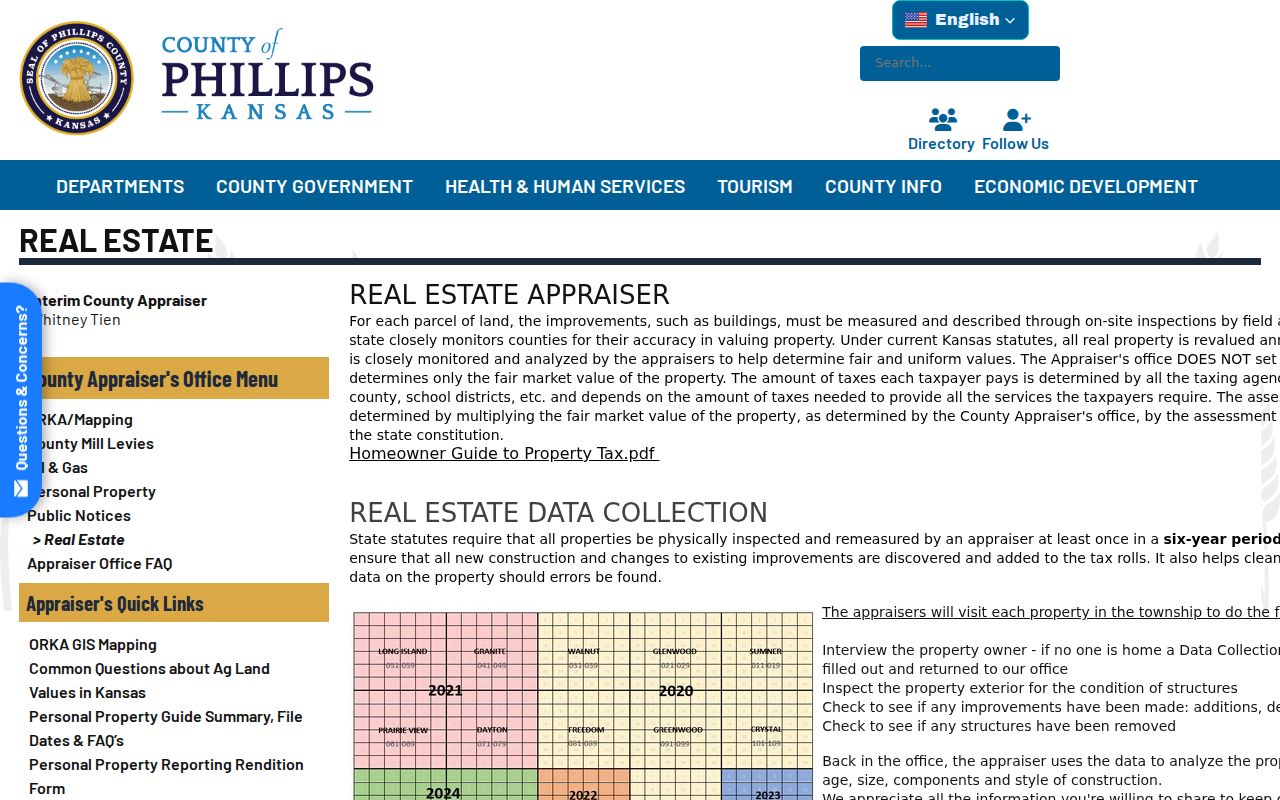
The Appraiser's value guidance covers method, not results. It explains how Phillips County approaches appraisal for property records. It does not display any selected property's current value. For an actual figure, request the parcel's Property Record Card. Read the card as a set of inputs. Confirm land use, class, acreage, building area, age, quality, condition, style, rooms, and outbuildings where shown.
A correction request should name the exact field believed wrong. Support it with photographs, a survey, permit history, or another official record. A general claim that the total feels high gives the Appraiser little to evaluate.
Compare values only at the same valuation date. Distinguish agricultural productivity from fair-market treatment. Also separate a permit's estimated construction cost from appraised improvement value. A permit may trigger inspection, but its declared project cost is not automatically the amount added to the assessment.
What Phillips County Assessor Value Is Not
The Appraiser's figure is a mass appraisal for property-tax administration. It is not a guaranteed asking price. Nor is it a purchase offer or lender appraisal. It is not an insured replacement cost or prediction of sale proceeds either. Buyers and sellers may still cite official characteristics and recent sales as evidence. For the transaction itself, obtain appropriate professional valuation. The last sale price deserves similar caution. It may be old, unusual, or based on different property rights. Label each figure's date, source, class, and purpose.
A record can also go stale. Ask when the relevant sale, permit, demolition, split, combination, or classification change entered county workflow. The Appraiser receives city permits and may inspect afterward. The office publishes no standard public correction form. No emailed-card policy, copy fee, or processing time is posted either. Call 785-543-6810 or email plcoappr@outlook.com and ask for the current procedure. Do not count on an online correction.
For estate planning, purchase diligence, or a possible sale, keep the official value in its role: a documented governmental estimate with a stated date and class. Pair it with deed records, survey, condition, and professional appraisal evidence as the decision requires. That discipline keeps countywide statistics, an illustrative formula, or an older levy table from standing in. It prevents them from standing in for one parcel's current value. In Phillips County, context makes a number useful.
Value vs price. A Phillips County assessor value supports taxation; it does not promise what the property will sell for in a particular transaction.