
Trace Former Phillips County Property Owners
Property records here reach back to 1873, according to the Register of Deeds FAQ. No deed images are online. The county offers no grantor-grantee index either, so every era of the chain ends in a recorder's office search.
| Source | Years It Covers | Where Held | What It Shows |
|---|---|---|---|
| Grantor-grantee index | 1873 to present, as available | Register of Deeds office | Parties and recording references |
| Deed books and instruments | 1873 to present | Register of Deeds | Conveyance, legal description, dates, references |
| Recorded plats and surveys | Varies by filing | Register of Deeds | Townsite, subdivision, lots, streets, easements |
| Patents and tract books | Initial public-land era | Federal/Kansas historical sources | Original entry and legal-description clues |
Begin with the latest known transfer, whatever era you hope to reach. An atlas can suggest a name. Only linked conveyances prove that person sat in the deed chain as a previous owner of the Phillips County parcel.
Phillips County Has No Online Deed Index
Phillips County says it plainly on its own terms: no e-recording, and no documents online. Requesters go through the Register of Deeds at 301 State Street, Suite B in Phillipsburg. The office also takes calls at 785-543-6875 and answers email sent to the posted Register of Deeds contacts. Hours run Monday through Friday, 8 a.m. to 5 p.m., with a noon-to-1 p.m. closure listed in the directory.
Staff work best with details. Share the address, the legal description, current and former names, the likely instrument, and a date range. Ask for the recorded reference before ordering pages. A missing web result means little here. It reflects how Phillips County provides records, not whether a former owner existed.
Build a Backward Ownership Worksheet
Log one row for every transfer. Note the execution, acknowledgment, and recording dates. Add the deed type, grantor, grantee, book/page or instrument number, full legal description, consideration language, and referenced prior deed. Keep mortgages, assignments, releases, easements, and liens on a separate list. Those instruments explain financing or use rights without identifying previous owners.
A clean worksheet exposes breaks in the chain. When an outgoing owner never appears as an incoming grantee, hunt for a probate decree, divorce order, affidavit of death, trustee instrument, name variant, or entity conversion. Document the gap rather than guessing who held title.
Walk the Phillips County Deed Chain Backward
Read each transfer in reverse order, but match the land rather than the surname. One owner may have conveyed several unrelated Phillips County parcels.
- Find the latest deed and verify its complete legal description.
- Copy the grantor, grantee, dates, deed type, and filing reference.
- Search the grantor as a grantee in an earlier acquisition.
- Repeat through the office index and deed books until reaching 1873, a patent, or a documented gap.
- Grantor / grantee
- The conveying and receiving parties named by an instrument.
- Chain of title
- The linked succession of recorded interests in the same land.
- Legal description
- The lot/block or section-township-range language that survives address changes.
- Reverse index
- An index arranged to locate the receiving party when tracing acquisitions.
Use Plats to Hold the Same Land in View
Town lots in Phillipsburg, Logan, and Agra carry townsite or subdivision, block, and lot descriptions. A recorded plat shows streets, alleys, dedications, and easements. That matters even when ORKA uses a newer parcel label. For rural ground, keep the section-township-range. Then hold on to the acreage, tract, road, creek, and patent references. The Register of Deeds holds plats and surveys.
A survey may clarify a boundary or explain a later split without conveying ownership. Cross-check with it, then return to the deed chain.
Follow Probate, Divorce, and Death Transfers
A former owner can vanish from the deed sequence. Title may have moved through probate, divorce, survivorship, or a court order instead. The County Clerk names probate and divorce decrees as ownership-transfer sources. K.S.A. 58-2242a requires original or court-certified records. A surviving joint owner may record an affidavit of death or a state-certified death certificate.
Kansas vital records are not open to public inspection. A recorded death instrument and a certified vital record are different documents with different access rules. Request only the property-related filing that bridges the chain.
Reach the Patent and Early Phillips Records
Phillips County formed in 1867, settlement took hold in 1869, and organization followed in 1872. That context makes the recorder's 1873 start meaningful. The Kansas Historical Society land guide separates original tract books, surveys, field notes, and plats from later county conveyances. A companion ownership-map guide covers rural landowners, roads, schools, churches, and cemeteries. Those map names guide a deed-book search. They are leads, not a recorded chain.
Handle Railroad-Era Names Carefully
Phillipsburg's townsite was laid out in 1872. Logan followed in 1873, and Agra began as a railroad station before incorporating in 1904. Railroad-era streets and variant spellings can break a name-only search. Search initials and alternate forms when staff allows. Then require the legal description to agree.
Phillipsburg Herald issues from 1882 through 1905, digitized in Chronicling America, may surface deed notices, plats, auctions, and local names. Newspaper evidence gives a lead, never proof of conveyance.
Distinguish a Transfer from an Encumbrance
Mortgages, assignments, releases, tax liens, fixture filings, and easements all name people tied to the land. None of them makes either party a former owner. Follow the granting clause and the instrument type. Assignments should point back to the original book/page, and releases need their referenced filing. A quitclaim does convey whatever interest the grantor held. It just carries different assurances than a warranty deed. This distinction keeps lenders, easement holders, contractors, and lien claimants out of the previous-owner history of a Phillips County property.
Inspect the Phillips Recorder's Official Access Page
The county's Register of Deeds page names the custodian. It also lists the range of instruments available for a former-owner investigation.
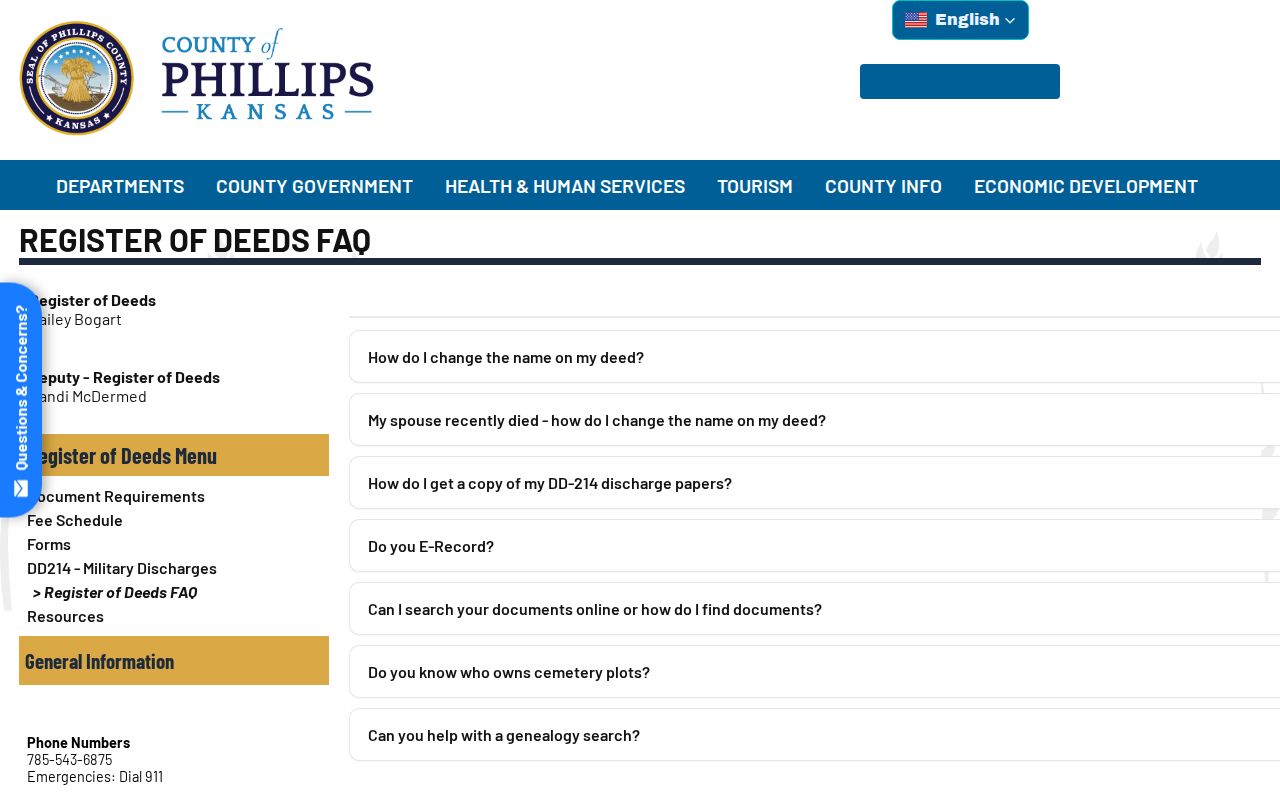
The recorder's official access page is a doorway, not a deed search result. It lists the contact details you need to request a specific index entry or instrument. Start there. Then ask staff for the recorded document itself.
The office keeps more than deeds. Its shelves also hold real-estate death certificates, powers of attorney, UCC filings that involve fixtures, and rural school records from the former county superintendent. Some of those school records reach back into the 1800s. Historical context helps, but every name deserves scrutiny. A secured creditor was not an owner. Neither was a school-board officer, a signer under power of attorney, nor someone named only in an affidavit.
Build a citation packet for each former owner. Include the document reference, the legal description, the relevant page, the access date, and a short note explaining why the instrument conveyed title. That discipline turns a loose list of names into a reconstructed chain that others can review later.
How Far Back Phillips Ownership Records Go
Phillips County ownership records reach back to 1873, according to the recorder. None of the deed index is online, though, so no complete digital series exists. Expect a chain to end somewhere. An original patent, a townsite conveyance, a missing cross-reference, an illegible volume, or an instrument needing professional interpretation can all stop your progress. Write down the last confirmed grantee. Describe the gap precisely. Then ask staff about adjacent index entries, plats, surveys, probate records, or patents.
Fees matter when ordering copies. Small non-UCC records run $0.50 per page, while indexes and reports cost $1 per page. Larger jobs, meaning more than an hour of work and over 50 pages, may be billed hourly under K.S.A. 45-219(c)(1). Confirm current fees before you order.
Some situations call for a professional title search. An unresolved gap can qualify. Conflicting legal descriptions, uncertain heir interests, unreleased encumbrances, or a planned transaction that depends on clean title also qualify. Keep your research worksheet and copies so the professional can see what you already covered. An informal reconstruction is still not an opinion of title.
Lawful use. Research Phillips County former owners for house history, estate work, or land diligence; never use the trail to track or harass a living person.