
What Phillips County Property Tax Records Reveal
The Phillips County Appraiser revalues real property every year and physically inspects each parcel at least once every six years. Read the tax record as a chain, not a lone number.
| Field | What It Shows | Where |
|---|---|---|
| Fair-market value | Appraiser's January 1 estimate | Appraiser |
| Assessment class and rate | Constitutional percentage applied to value | Appraiser |
| Assessed value | Taxable base before levy calculation | Appraiser / Clerk |
| Combined mill levy | County, city, school, cemetery, fire, and other districts | Clerk |
| Bill and payment status | Amount due, receipt, or delinquency information | Treasurer |
Classification drives the math in Phillips County. Residential and farm homesites are assessed at 11.5%. Vacant lots and nonprofit property sit at 12%. Agricultural buildings, commercial, and industrial property carry 25%. Agricultural land is assessed at 30% on productivity rather than market value. Public utilities are assessed at 33%. Because each class applies a different rate to value, two parcels of equal worth can owe very different Phillips County property tax amounts.
Phillips County Property Tax Offices Divide the Work
Three offices split the Phillips County property tax job. The Appraiser sets classification and value. The County Clerk applies the rate and levies, then certifies the roll. The Treasurer collects real-estate and other taxes and distributes the proceeds. Take a valuation dispute to the Appraiser first. Receipts, payments, and delinquency questions go to the Treasurer.
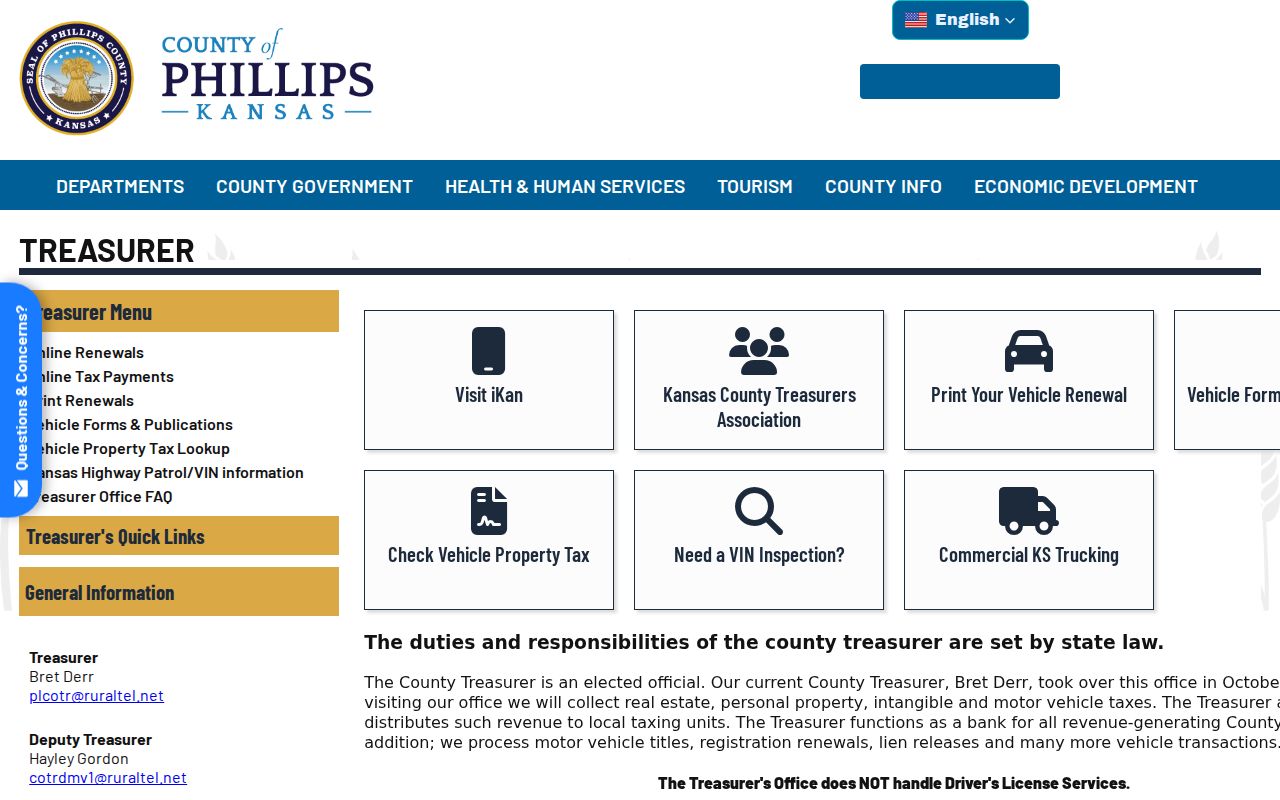
The Treasurer's page is the official home for Phillips County payments and receipts. It does not carry the Appraiser's valuation record or the Clerk's certified roll, so parcel research still starts elsewhere.
Read Phillips County Mill Levies by Year
The county's mill-levy page breaks down levies by schools, cities, cemeteries, fire districts, and county government, with historical tables covering 2019 through 2022. The formula itself is simple. Multiply assessed value by the combined mills, divide by 1,000, then adjust for any credits, exemptions, or special assessments. Label every result with its tax year.
Consult the county's published mill-levy index for year-labeled taxing-district material.
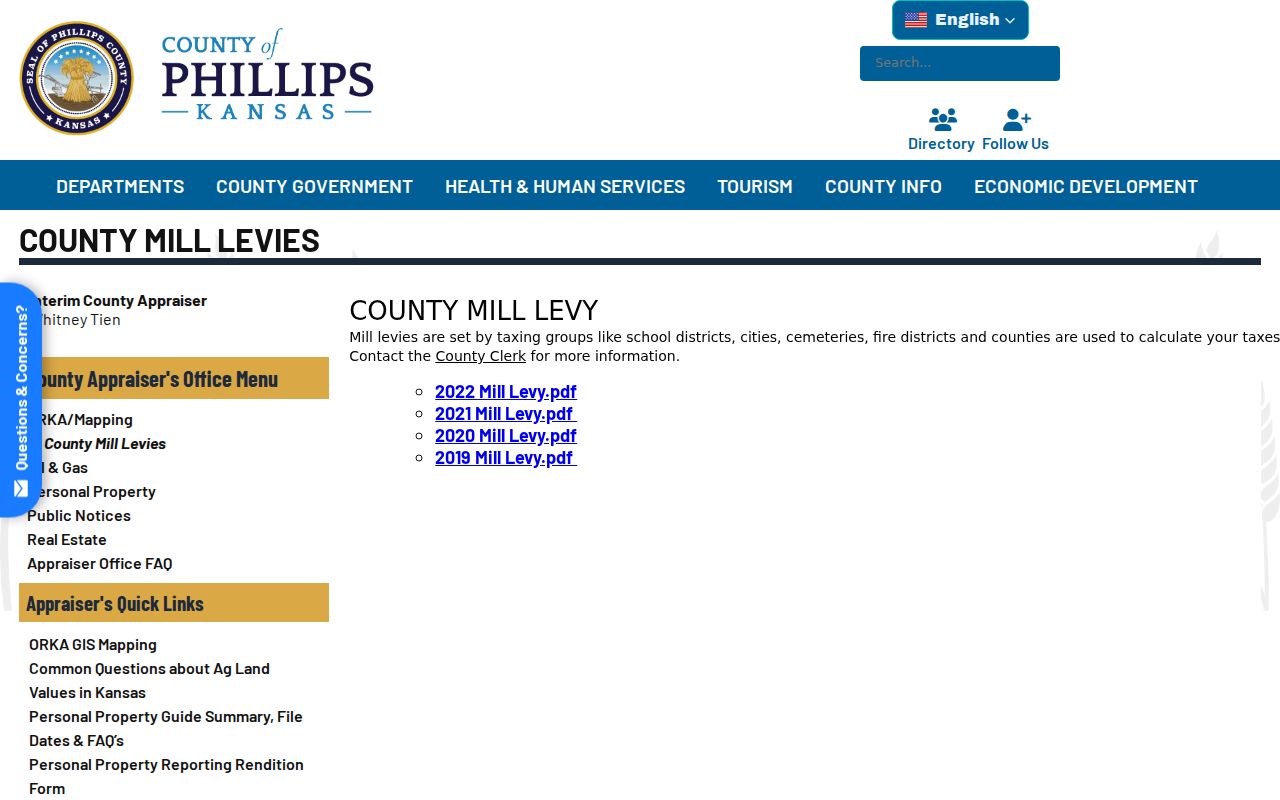
A mill levy gives district context only. The parcel's assessed value and its statement are what produce an actual Phillips County tax bill.
Countywide 2024 Values Are Context, Not a Quote
The Kansas 2024 Phillips summary reports $87,597,433 in total taxable value, $16,236,272 in ad valorem tax, and a 0.185351 average mill levy. Commercial real property held 27.68% of taxable value, residential 26.10%, and agricultural land 25.63%. Those countywide totals sketch the local property mix. They cannot price one parcel or predict one bill.
Look Up a Phillips County Tax Bill
The county hosts no public account-search screen of its own. The Kansas Property Tax Payment portal opens with a county selection and requires the tax statement in hand, so treat it as a payment channel rather than a certified roll search. The amount it shows may include a portal service charge.
- Match the statement to the parcel number and legal description.
- Compare its assessed value and tax year with the Appraiser record.
- Review each taxing district and the combined levy.
- Ask the Treasurer for a historical bill, paid receipt, delinquency status, or tax-sale information not shown online.
- Assessed value
- The class-adjusted value used as the tax base.
- Mill levy
- Dollars of tax per $1,000 of assessed value.
- Special classification
- Legal treatment that changes the assessment basis or rate.
- Tax lien
- A recorded or statutory claim arising from unpaid tax, not a deed.
Follow the Kansas Property Tax Calendar
Value is fixed as of January 1 and notices are mailed March 1. The current Kansas calendar lists certification, statement, and payment milestones, including December 20 and May 10 payment dates. Because dates can shift by tax year, use the live calendar and preserve the notice mailing date rather than relying on a timeless summary.
Calculate a Phillips County Assessment by Class
The county's published example uses a $150,000 fair-market value for a residence. At the 11.5% residential rate, that yields a $17,250 assessed value. A hypothetical 120 mills would then produce $2,070 before other adjustments. Phillips County labels this an illustration, not a quote for any real parcel.
Agricultural land reads differently. Productivity and use set its value, not a residential sale comparison. Agricultural buildings carry their own rate. Commercial, industrial, vacant-lot, nonprofit, utility, and other rural or urban classes each have separate percentages. Some are rural. Some are urban. Before comparing two tax records, confirm both parcels share the same class. Also confirm the same tax year, taxing districts, and valuation basis. Otherwise the comparison misleads.
Fair-market value is the Appraiser's estimate under the applicable method. Assessed value applies the constitutional class rate. Taxable value reflects the base after any treatment, and mill levy expresses tax per $1,000 of assessed value.
Read the Phillips County Valuation Notice
The March 1 notice reports value as of January 1. County guidance says current and prior-year history may be available, and the Appraiser considers age, quality, condition, location, style, size, sales, permits, and boundary changes. The office physically inspects each parcel at least once every six years, with additional visits when events call for review.
A Property Record Card may show square footage, rooms, outbuildings, and other characteristics behind the value. Ask the Appraiser at 301 State Street, Suite C, Phillipsburg, or call 785-543-6810 when a measurement, class, use, or improvement looks wrong. A correction question is not the same as a tax payment question, which belongs to the Treasurer.
Note: Compare the notice to the underlying Property Record Card before appealing; a wrong characteristic may explain the value more clearly than the total alone.
The Appraiser's real-estate guidance documents annual valuation, property classes, and the notice process behind Phillips County property tax records.
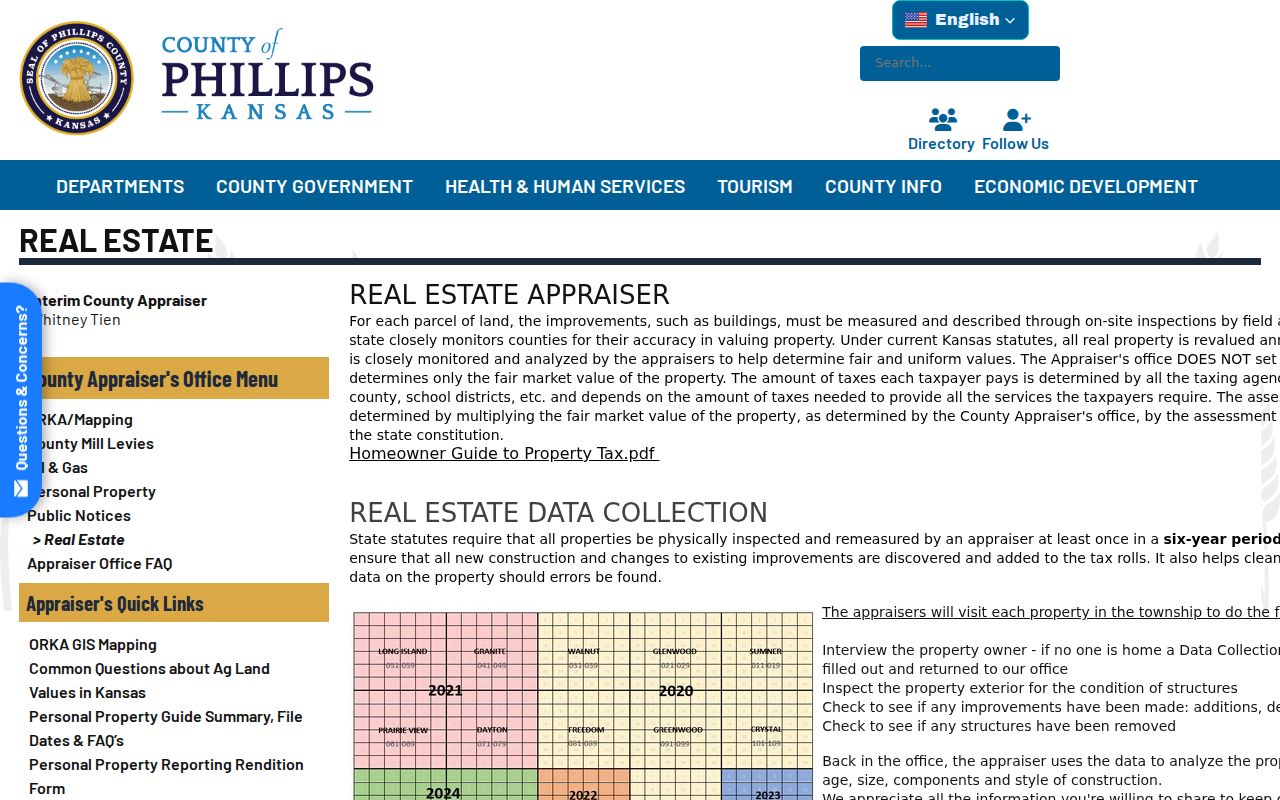
That official page gives the valuation context. Testing the characteristics behind one Phillips County assessment still takes the parcel's Property Record Card.
Choose the Right Phillips County Tax Access Channel
Phillips County offers no documented public account-search interface with confirmed field labels. The Kansas payment route is another option. It requires the tax statement and may add a service charge. Neither route answers the question? Go straight to the county offices. Skip unofficial substitutes.
| Need | Custodian or channel | Request detail |
|---|---|---|
| Value, class, parcel characteristics | County Appraiser | Parcel ID, address, legal description, tax year |
| Certified roll or levy context | County Clerk | Tax year and taxing district |
| Bill, receipt, payment, delinquency | County Treasurer | Statement and parcel identifiers |
| Online payment | Kansas property-tax portal | County selection and current statement |
| Historical public record | Narrow KORA request | Exact record, date range, and delivery choice |
The Treasurer works out of the county complex. Call 785-543-6895 with questions about any Phillips County tax bill or delinquency. The tax office keeps hours from 7:30 a.m. to 5 p.m., and it posts those hours publicly, so always ask about copy or research costs before requesting a broad search of the tax roll.
Separate Phillips County Delinquency from a Tax Sale
Delinquency comes in stages. An unpaid balance, a delinquency notation, a tax lien, and a completed tax-deed transfer each mean something different. Phillips County publishes no official online tax-sale list and no full delinquent-account interface, so ask the Treasurer for the current status on any parcel and year. The office can also tell you exactly which public record exists for that account. If litigation or a sheriff's deed shows up, reconcile it against court records and the deed records at the Register of Deeds. A payment-portal message never proves a parcel changed hands. A tax receipt shows payment activity, not ownership. Likewise, a missing online result does not mean no tax is due. Keep the tax year, parcel number, statement number, amount category, and the custodian's response on file.
Understand Phillips County Taxing-District Differences
One Phillips County bill can carry several levies. County, city, school, cemetery, fire, and other district lines all feed the combined rate. Two nearby parcels with similar assessed values may still get different bills. The reason is simple. They sit in different taxing districts. A mailing city or ZIP settles nothing. Rely on the legal parcel and the year-specific levy table kept through the county process. Revenue-neutral-rate talk and countywide averages add context, but they never replace the parcel statement. The 2024 state summary's average levy blends many property and district circumstances. For a precise tax record, pair the parcel's class-adjusted assessed value with its own certified levy. Then add any special assessment or credit.
Request Historical Phillips County Property Tax Records
Need an older bill, levy, receipt, or roll entry? Send a narrow request to the office that created or keeps that record. Identify the parcel number, the owner of record as labeled that year, the legal description, the tax year, and the exact document. The Kansas Open Records Act, K.S.A. 45-215 et seq., frames public access. It does not promise an online database or that one office holds every tax component. Ask about format, estimated copy or staff cost, and delivery method first. Each office has its lane. The Clerk handles certified-roll and levy context. The Treasurer handles statements, receipts, payments, and delinquency. The Appraiser maintains valuation and classification. If a historic entry uses an old parcel description, carry that wording alongside the modern parcel ID. Never assume the two describe different land. Keep closed or redacted data closed. A tax record supports parcel and payment research, not a title conclusion. If the historical question turns on who acquired the land, follow any tax-deed or court clue to the recorded instrument at the Register of Deeds.
Challenge a Phillips County Assessment
An equalization appeal starts with the Appraiser. The deadline is generally 30 days from the mailed notice. Preserve the envelope, parcel number, card, photographs, and comparable sales. Then state a precise disagreement about class, measurement, condition, or market evidence. Kansas also offers payment under protest. But that route has separate timing and is unavailable after a valuation appeal for the same year. Consult the state appeals guidance for details.
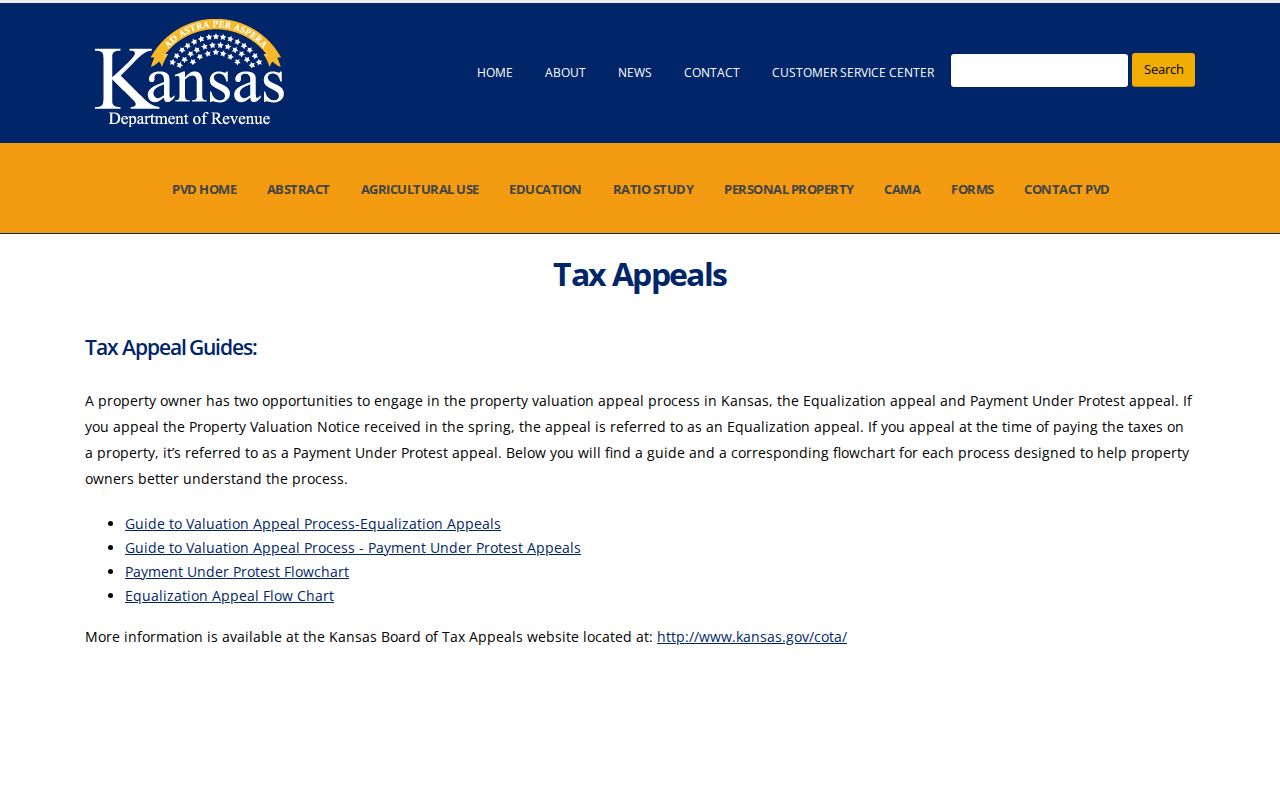
The Kansas guidance draws a clear line between equalization and payment under protest. Follow the current year instructions, because the two routes run on different clocks and cannot be combined freely.
Appeal window. Contact the Phillips County Appraiser promptly after the March 1 notice; the ordinary equalization period is 30 days from mailing.